

Is Buying a Vermont Rental Property Worth It in 2026?
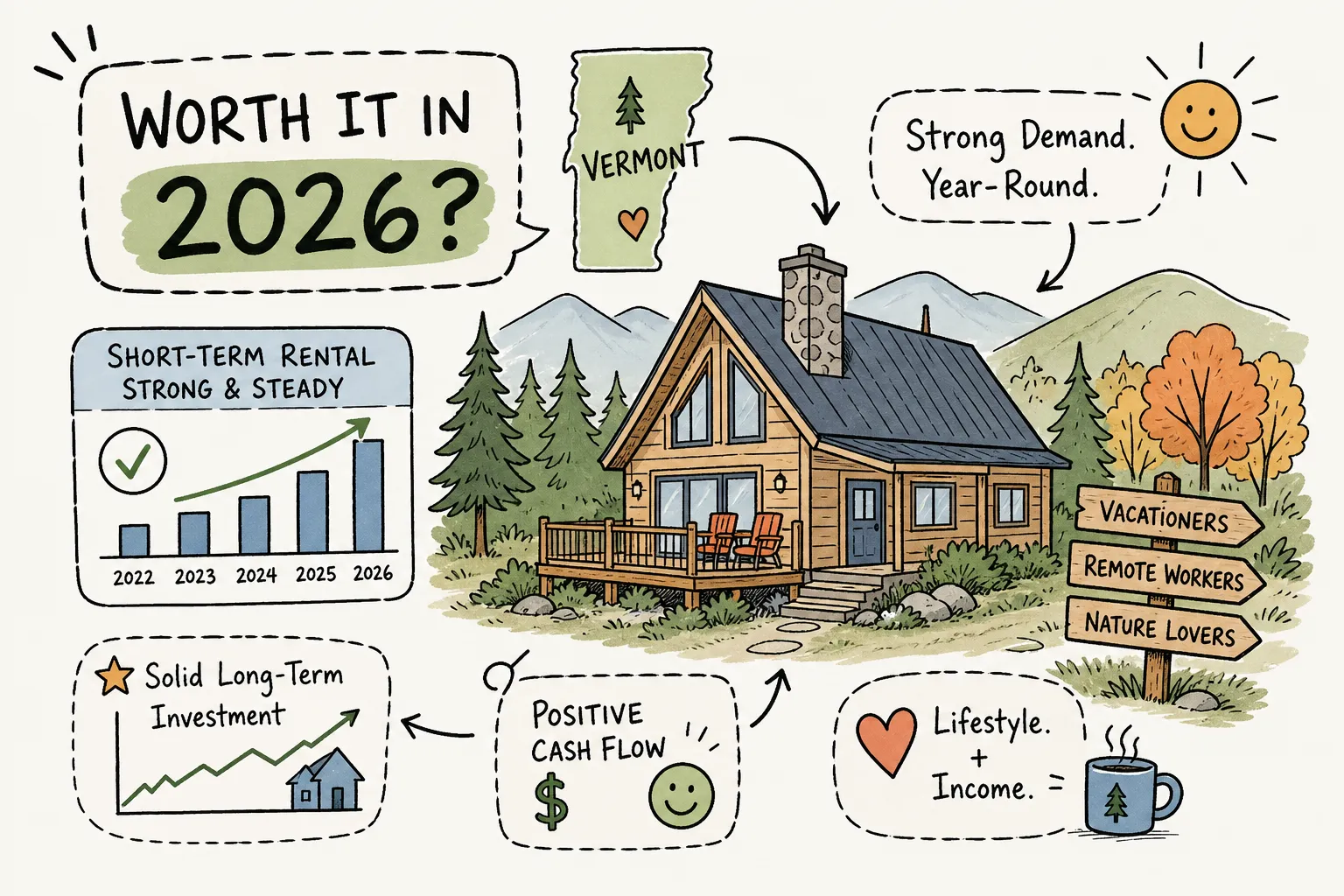
Is buying a rental property in Vermont a good investment in 2026? Every investor asking that question is really asking one thing: does the math actually work, or have prices climbed far enough ahead of rents to kill the deal before it starts? The honest answer is that it depends on where you buy, how you structure the financing, and whether you're willing to run the numbers without rose-colored glasses. Vermont is not a slam-dunk rental market right now, but it's not a dead one either. The investors who do well here share one trait: they treat underwriting as seriously as they treat the purchase price.
Vermont's rental market is uniquely local. Burlington and Stowe operate on entirely different economics than Rutland or Brattleboro, and the regulatory landscape for short-term rentals has shifted significantly in 2026. This guide covers rents, costs, strategy, and a clear decision framework grounded in current market data. For investors who want that kind of on-the-ground insight, working with an agent who understands Vermont rental properties from both sides of the transaction, buying and operating, changes what you're able to see in a deal before you're committed to it. Chad Dion Real Estate brings that dual perspective to every investment property evaluation.
Is buying a rental property in Vermont a good investment? Market conditions in 2026
Where rents actually stand across Vermont's major markets
Statewide, one-bedroom apartments are averaging $1,845 to $2,097 per month depending on the market, and two-bedrooms are running $2,007 to $2,464 per month, based on Apartments.com August 2026 data. Burlington leads the state at $2,097 for a one-bedroom, while Winooski's two-bedroom units are averaging $2,464. Smaller markets like Brattleboro and Rutland run materially lower, which is exactly why those markets attract investor attention. Conservative underwriting always uses the low end of any rent range; if the deal only works at peak rent, it doesn't work.
Vacancy rates and what they signal for income stability
Vermont's statewide rental vacancy rate sits at approximately 3.0% as of the most recent available data, well below the healthy-market threshold of 4, 6%. That tight supply generally supports stable occupancy for well-located units, but vacancy is still one of the most underestimated line items in any landlord's budget. Even one extra month vacant per year on a unit renting at $1,800 wipes out $1,800 of annual income. Two months costs you $3,600. That's the difference between a deal that pencils and one that doesn't. For long-term rental underwriting in Vermont, plan for 5, 10% vacancy annually, and use the higher end of that range for smaller markets where the renter pool is thinner.
Which Vermont markets show the strongest long-term rental demand
Chittenden County, Burlington, Winooski, South Burlington, is the strongest market for consistent tenant demand, driven by the University of Vermont, medical community employment, and a tight housing supply. The tradeoff is entry price: Chittenden County median home values run $515,000 to $549,000 in 2026, which compresses returns. Rutland County offers a more accessible entry point at $316,000 to $379,000 with year-over-year appreciation of 4.1%, the strongest among tracked counties in the state. Brattleboro sits at $344,500 and Montpelier at $395,000. Statewide, Vermont home prices are up 2.3% to 4.2% year-over-year in 2026 depending on the source, which supports the long-term equity thesis even when near-term cash flow is thin.
Running the cash flow math: what the numbers actually say
A realistic operating cost breakdown for Vermont rentals
Vermont landlords face a cost structure that punishes lazy underwriting. Property taxes on non-homestead rentals run at the statewide non-homestead education tax rate of $1.703 per $100 of equalized education property value for FY 2026, which translates to roughly 1.42% to 1.83% of property value annually when combined with municipal rates. That's a meaningful line item on any deal. Add insurance, a maintenance reserve, and property management if you're not self-managing, and combined operating costs, excluding debt service, typically land in the 20, 35% of gross rent range. Use 30% as your base case; go higher if the property is older or you're hiring a manager.
Is buying a rental property in Vermont a good investment, cash flow examples
Here's a concrete example using Rutland County, the most accessible market for cash-flow-focused investors. A $380,000 duplex with a two-bedroom unit renting at $1,800 per month generates $21,600 in gross annual income. Subtract 30% for operating costs ($6,480) and you're left with net operating income of $15,120. At a 25% down payment ($95,000 down), a conventional investment property loan on $285,000 produces monthly debt service in the range of $1,750 to $1,900, depending on rate, roughly consistent with 30-year fixed rates in the 7.0%, 7.5% range at current market pricing. That's $21,000 to $22,800 annually. The resulting cash-on-cash position is thin or slightly negative unless rents are at or above the market midpoint and the property stays occupied. The deal makes more sense at 30% down or if you can negotiate a purchase price below $360,000.
What implied cap rates look like under honest underwriting
Vermont county-level cap rates for 2026 range from 3.0% in Addison County to 3.9% in Bennington County, with Chittenden County at 3.1% and Rutland County at 3.6%. The Burlington, South Burlington metro area shows a 4.51% cap rate in market summaries. These numbers confirm what the cash flow model shows: Vermont is not a high-yield rental market on a pure income basis. A 3.5% cap rate on a $380,000 property implies net operating income of $13,300, which leaves very little room for debt service on a leveraged deal. Vermont home prices rose 2.3% to 4.2% year-over-year in 2026 depending on source, which makes the equity case real, but investors who need positive monthly cash flow from day one should target lower-priced properties with higher rent-to-value ratios and run the numbers on every deal individually.
Short-term vs. long-term rental: choosing the right Vermont strategy
STR income potential in Vermont's tourist corridors
Stowe is the benchmark for Vermont vacation rental income, and the AirDNA 2026 data tells a nuanced story. Average daily rates run $529 to $555, but occupancy sits at roughly 38%. That occupancy figure is the one most investors miss when they read the ADR headline. At 38% occupancy on a $540 ADR, a property available year-round produces about 139 occupied nights and roughly $75,000 in gross annual revenue before platform fees, cleaning costs, property management, and the higher maintenance demands of short-term rentals. At a $790,000 Stowe median purchase price, that gross revenue needs to cover a much heavier cost structure than a long-term rental. The math can work in Stowe, but only with disciplined expense modeling and realistic occupancy assumptions, not the 60, 70% occupancy projections that some marketing-oriented STR summaries use to represent the upside case.
Local STR regulations you must understand before you buy
Stowe adopted new short-term rental regulations on July 22, 2026: an 850-unit cap, mandatory town permit, and Vermont state registration are all required. Burlington applies a 9% local tax on top of 12% in state taxes on STR income. Across Vermont, towns are actively moving toward permit caps or outright restrictions, Stowe's July 2026 cap is one of the clearest examples, and other municipalities have similar measures under discussion. Buying a property where the investment thesis depends entirely on STR revenue, without verifying current and pending local regulations, is one of the most common and costly mistakes Vermont investors make right now. Before you close on any STR-dependent property, confirm that a permit is currently available, not just that it was available when the listing agent ran the numbers.
Vermont landlord laws and the regulatory risks investors face
Regulatory risk doesn't end with STR restrictions. Vermont's landlord-tenant rules shape your cost exposure and timeline on every long-term rental, and understanding them before you buy is as important as modeling the rent.
Eviction timelines and what they mean for your exposure
Vermont is not an anti-landlord state in the way some markets are, but its eviction process is slower than most investors expect. Nonpayment of rent requires 14 days' written notice before a landlord can proceed; a lease violation requires 30 days; and a month-to-month termination requires 60 days for tenants of two years or less, or 90 days for longer tenancies. If a landlord misses the court filing window, which must be opened within 60 days of the termination date, the process resets from the beginning. A tenant dispute that runs 4, 5 months adds $7,000 to $9,000 in lost rent to a property renting at $1,800 per month, on top of any legal fees. That's an expense line that only careful tenant screening can prevent.
Security deposits, entry rules, and no-self-help requirements
Vermont law requires landlords to return security deposits within 14 days of tenant vacating, with an itemized statement of any deductions. Vermont statute requires landlords to give advance notice before entering a unit, verify the exact current requirement under 9 V.S.A. § 4460, as summaries vary between 40 and 48 hours depending on the source, and entry is restricted to between 9 a.m. and 9 p.m. There is no self-help eviction of any kind; all removals go through the court system. Vermont also enacted legislation in 2025 prohibiting landlords from requiring a Social Security number on rental applications, and H.772 remained under discussion as of mid-2026, with additional tenant protections under consideration. These rules don't make Vermont a bad state for landlords, but they reward investors who screen tenants carefully and document everything from the first day of occupancy.
A practical framework for deciding whether to buy or walk away
The market conditions that favor buying in Vermont right now
Rutland County stands out as the most practical entry point for cash-flow-focused investors in 2026. With median home values in the $316,000 to $379,000 range, 4.1% year-over-year appreciation, and two-bedroom rents competitive with state averages, the rent-to-value ratios are more workable than Burlington or Stowe. Multi-unit properties, duplexes and triplexes, outperform single-family rentals in Vermont because rental income from multiple units reduces dependence on any single tenant's payment. Buyers who can put 25, 30% down, target multi-unit properties, and hold for 7, 10 years are in the strongest position to benefit from Vermont's steady appreciation while riding out any thin cash flow in early years.
When the deal doesn't pencil and what to do instead
If a Vermont rental property shows negative projected cash flow after running a realistic operating cost model, 30% of gross rent, plus actual debt service, and the only investment case rests on appreciation, that's speculation, not investing. Walk away from deals where the numbers only work if rents rise, expenses stay flat, and the market keeps climbing. Vermont's appreciation trend is real and supported by tight inventory, but no investor should depend on future appreciation to bail out a deal that doesn't work on its own fundamentals today. If the only path to a positive return requires things to go right that you can't control, find a different property.
Why your agent's investor experience changes what you see in a deal
Evaluating a Vermont rental property is a fundamentally different skill set than buying a primary residence. The questions you need answered go beyond square footage and school districts: What are the actual operating costs for a property this age? Does the rent-to-value ratio support the loan structure? What's the realistic vacancy assumption for this submarket? An agent who has personally underwritten, purchased, and managed Vermont rental properties knows how to read a deal's true operating cost structure, not just the list price. Chad Dion Real Estate brings that firsthand landlord and investor experience to every rental property evaluation, which matters when you're deciding between a deal that works and one that only looks good on paper until it doesn't.
The bottom line on Vermont rental investing in 2026
So, is buying a rental property in Vermont a good investment in 2026? The answer is yes, conditionally. Tight vacancy, steady appreciation, and genuine long-term housing demand create a real investment case. High non-homestead tax rates, slower eviction timelines, rising STR regulation, and compressed cap rates create real headwinds. The investors who do well here are the ones who run honest numbers before they fall in love with a property, pick the right market for their strategy, and work with people who understand both the real estate transaction and the ongoing landlord operation.
Location, purchase price, financing structure, and rental strategy all determine whether a Vermont rental property delivers returns or just eats capital. The analysis starts with your market, your costs, and a rent assumption grounded in data, not optimism.
If you're seriously evaluating whether to invest in Vermont real estate, reach out to Chad Dion Real Estate for a conversation grounded in actual Vermont investor experience. There's no pressure and no script, just an honest look at whether a specific property or market makes sense for your goals, from a team that understands both sides of the Vermont landlord equation.



Connect