

Buying Rental Property in Vermont: An Investor's Guide
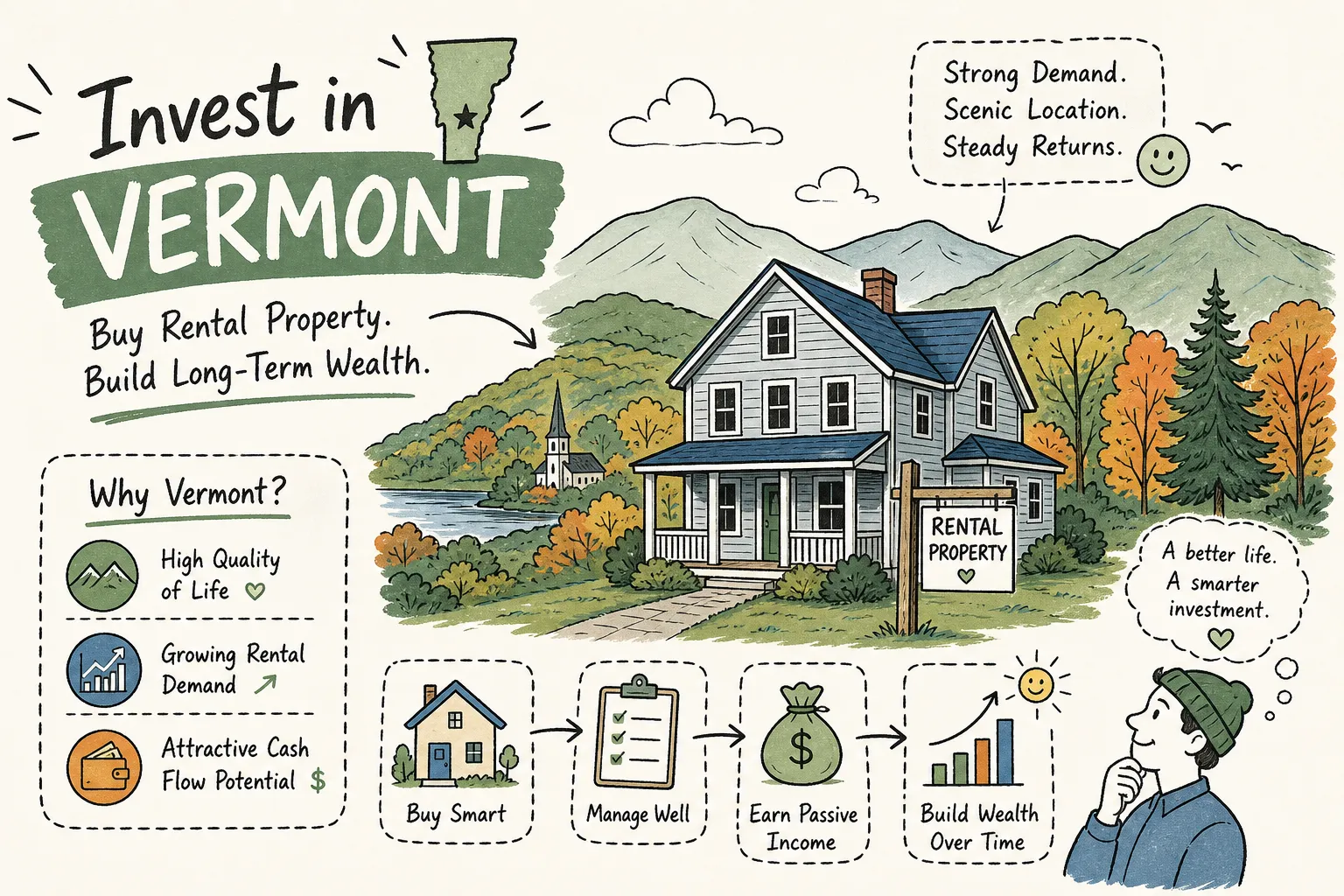
Vermont's rental market is smaller than many larger-state coastal markets, and that's part of what makes it interesting for investors willing to do the homework. The state's tight housing supply, university anchors, tourism corridors, and concentration of government employment create pockets of durable rental demand that hold up across market cycles. This guide walks through the key variables any serious buyer needs to evaluate before making an offer on rental property in Vermont. It draws on decades of local experience in Vermont real estate and firsthand operation of rental properties here, the same dual perspective that defines the approach at Chad Dion Real Estate. Whether you're evaluating your first income property or adding to a portfolio, the goal is a realistic, Vermont-specific framework for making a decision you can stand behind.
Long-term vs. short-term: The decision you make first
Before you search a single listing, you need to make one foundational choice: long-term residential rentals or short-term vacation rentals. These are different businesses with different cash flow profiles, operating demands, and legal exposures. The choice determines what towns, what neighborhoods, and what property types belong on your radar, so make it before you start scrolling VT rental listings.
Long-term rentals, meaning 12-month leases to primary-residence tenants, offer predictable monthly income and lower operating overhead. Vacation rentals offer higher nightly rates but require furnished properties, active management, platform dependency, and compliance with a growing layer of local regulation. Neither model is universally superior; each fits a different investor temperament and capital situation.
Why Vermont rental demand holds up across market cycles
On the long-term side, tenant demand in Vermont is anchored by several durable forces. College enrollment at the University of Vermont and Champlain College contributes meaningfully to rental demand in Burlington. State government concentration in Montpelier keeps occupancy stable through economic cycles. Stowe's year-round resort economy supports a mix of both rental models. Mid-market cities like Rutland and Barre carry lower purchase prices and maintain relatively stable tenant demand, which can produce stronger cap rates than the headline Burlington numbers suggest. Investors who focus only on Burlington often miss better-yielding deals in markets located well outside the city.
Vermont apartments for rent in smaller cities and towns often sit on the market longer simply because fewer investors are looking there, not because demand is weak. Understanding where durable employment exists, and where it doesn't, is the single most important filter you can apply when evaluating Vermont rental properties.
Realistic rent ranges for rental property in Vermont
Treat rent figures as gross income starting points that need to be stress-tested, not as the answer to your investment question. In 2026, Burlington averages approximately $2,057 per month across unit types. South Burlington ranges from roughly $1,800 to $2,100 depending on unit mix and data source. Montpelier sits near $1,425, Rutland near $1,400, and Stowe reports roughly $2,050 for a one-bedroom, with larger or seasonal units running higher. The statewide average lands around $1,826 per month based on aggregated platform data.
None of those numbers mean anything until you set them against purchase price, operating expenses, and a realistic vacancy assumption. A $2,057 Burlington rent sounds strong until you model the $400,000 purchase price, the 2.27% combined property tax rate, oil heat in a multi-unit building, and a vacancy buffer. The math changes fast.
Cap rates by city
Vermont is not a high-cap-rate market. Burlington and South Burlington properties typically produce cap rates in the 3 to 5 percent range when priced at market value. Rutland and Montpelier can push closer to 4 to 6 percent depending on the asset. Projected cap rates above that range typically rely on omitted expenses or optimistic vacancy assumptions. A properly calculated cap rate includes property taxes, insurance, maintenance reserves, management costs, and vacancy, not just the mortgage payment. Investors who omit any of those line items are not calculating a cap rate; they're calculating a hope.
Location factors for Vermont rental property
What makes a Vermont location durable for long-term tenants is straightforward: proximity to major employers, year-round road accessibility, quality of local schools, and a reasonable service base. Properties in towns where the employer base is thin or entirely seasonal carry meaningfully higher vacancy risk. Burlington-area communities including South Burlington, Essex Junction, and Williston score well on employment access, stability, and year-round consistency. Montpelier and Barre provide stability for state-government workers. These are not glamorous markets, but they're consistent ones.
The contrast is rural locations with low purchase prices but limited employment. The lower entry cost can look attractive until you run vacancy rates through your model honestly. A property sitting empty for two months in a market with no employment anchor erases months of positive cash flow. The question is never just what it costs; it's what keeps it occupied.
For vacation rental investors, Stowe, the Northeast Kingdom, and the ski-corridor towns offer real short-term rental premiums, but the vulnerabilities are equally real. Stowe requires registration before operating, carries a $100 registration fee per unit, mandates a designated responsible person who can respond on-site within 45 minutes, and collects a 1% local option tax on top of Vermont's standard 9% Meals and Rooms Tax and 3% short-term rental surcharge. Burlington's requirements are more restrictive, with annual registration, owner-occupancy rules, and bedroom limits applying in most cases, verify current requirements directly with Burlington's municipal office, as local ordinances can change. Seasonal income concentration and platform dependency compress actual net returns in ways that best-case projections rarely capture.
Vermont landlord laws every investor must understand before closing
Vermont prohibits charging any application fee to prospective tenants, regardless of what the charge is labeled. A fee called a processing fee, a credit-check fee, or an administrative fee is still prohibited under state law. Landlords must also accept an Individual Taxpayer Identification Number or a valid government-issued ID as alternatives to a Social Security number, and cannot reject an applicant solely because they did not provide an SSN. Credit and background checks require written consent, and federal adverse-action notice requirements apply whenever a consumer report contributes to a denial, a deposit increase, or a co-signer requirement.
These rules affect how you underwrite tenant risk and how you budget for the leasing process, for example, you can't offset screening costs with application fees, so that expense needs to be factored into your operating budget from the start. Investors who learn these rules during their first tenancy dispute rather than before acquisition pay for that education twice.
Vermont's other landlord-tenant provisions directly shape your operating model in ways that need to be modeled upfront. Security deposits have no statewide dollar cap but must be returned with an itemized written statement within 14 days of vacancy. Missing that deadline forfeits your right to withhold any portion, and willful violations can result in liability for double the amount wrongfully withheld. Entry requires at least 48 hours' notice for routine purposes, between 9 a.m. and 9 p.m. Rent increases require at least 60 days' actual notice and take effect only at the start of a rental period. These are not technicalities; they're the operating rules of your investment.
How to evaluate a rental property in Vermont before you make an offer
The full expense stack for a Vermont rental property includes more variables than investors from other markets typically expect. Property taxes vary significantly by town: Burlington's combined rate runs approximately 2.27%, Montpelier sits near 2.35%, Rutland City around 2.45%, and Stowe at roughly 1.95%. On a $350,000 property, the difference between Stowe and Rutland City is over $1,750 per year before you've touched any other expense.
Heating costs require equal attention. Oil heat on a multi-unit Burlington property can run $2,839 annually per two-bedroom unit. Propane for a three-bedroom unit runs approximately $2,347 per year under standard benchmarks. Natural gas, where available, comes in around $1,148 for a two-bedroom. The fuel type matters most when the landlord pays it, as every dollar of owner-paid heating expense reduces net operating income directly. Switching a 10-unit oil-heated building to natural gas where feasible can produce five-figure annual NOI improvement, but only if the infrastructure supports it and the numbers justify the capital cost.
One variable that frequently distorts pro forma projections is the gap between current rent and market rent, especially in long-tenanted units. A property with a tenant who has been in place for six years at below-market rent is not earning what the market would support. That gap is a valuation factor during negotiation, not just an upside projection after closing. An investor who pays market price for a property earning below-market rent has already given away part of their return before the first rent check arrives.
This is where working with an agent who operates Vermont rental properties firsthand changes the quality of your evaluation. At Chad Dion Real Estate, the perspective on an investment property isn't borrowed from a textbook. Chad has absorbed oil bills, navigated Vermont's landlord-tenant framework, worked through vacancy cycles, and evaluated mechanical systems with the eyes of someone who owns the consequences. For a buyer trying to separate a real return from a projected one, that firsthand landlord experience is a meaningful filter during the offer and due-diligence phase, a practical difference in how deals get read.
Making a decision you can stand behind
Buying rental property in Vermont is a deliberate decision, not a passive one. The market is small, inventory is tight, and the legal and seasonal dynamics are genuinely different from what investors encounter in larger markets. The investors who do well here understand their income model before they shop, run honest numbers without optimistic assumptions, and know what the landlord-tenant legal framework actually requires of them day to day.
The seasonal energy costs, the local permit requirements, the town-specific tax rates, the tenant screening rules, none of these are obstacles so much as they are information. Investors who treat them as inputs rather than surprises make better offers, underwrite more accurately, and run smoother operations once they close.
If you're evaluating houses for rent in Vermont or considering Vermont rentals near Burlington VT as part of a broader portfolio strategy, a conversation with someone who has operated in this market as both a licensed agent and an active landlord is worth your time. Chad Dion Real Estate is a practical first call. Get in touch directly to talk through what you're looking at. The combination of decades of transaction experience and hands-on property ownership is not something most agents can offer, and in a market this specific, that difference tends to show up exactly where it counts.



Connect