
Vermont first-time home buyer down payment guide 2026
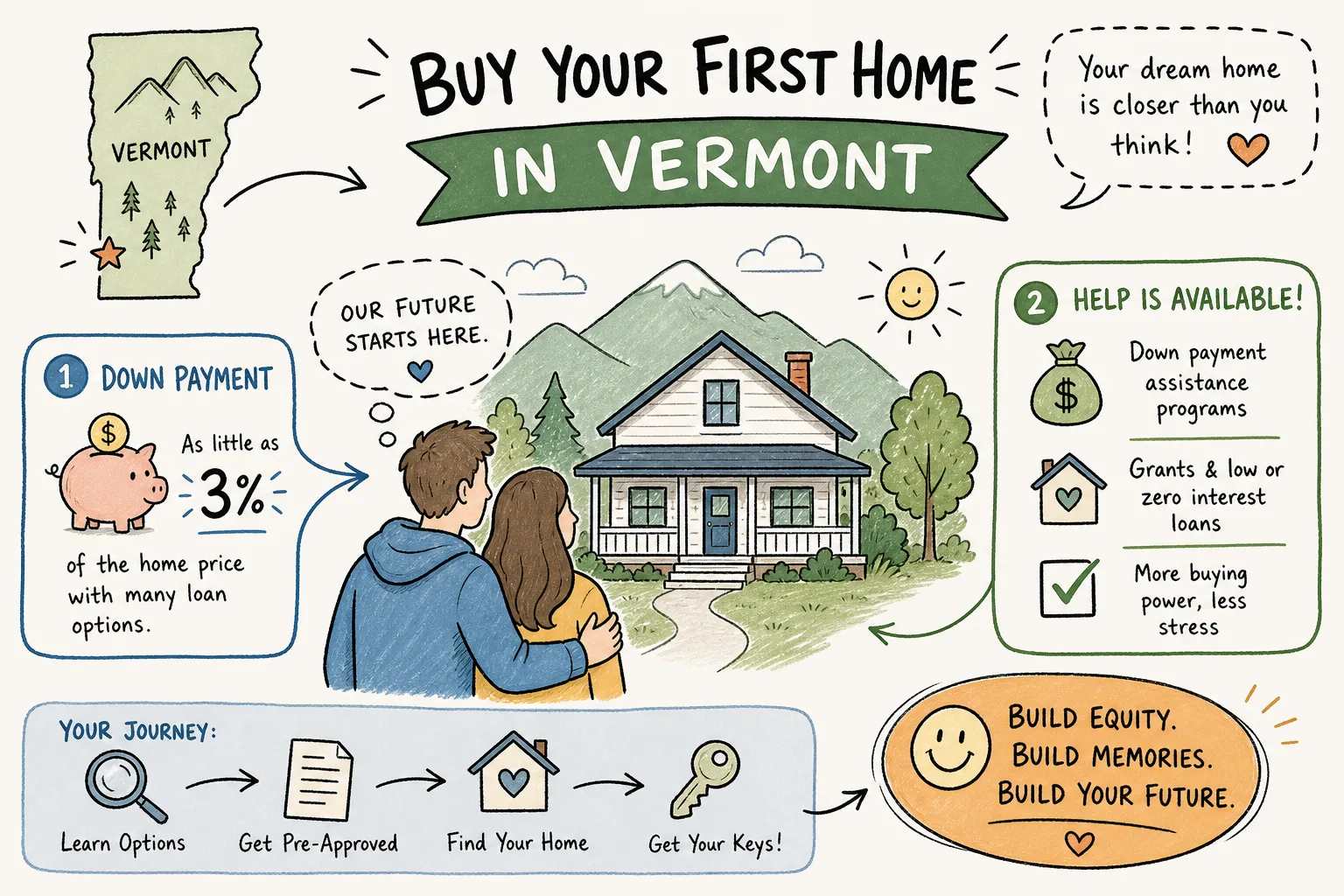
Vermont offers several real down payment and closing cost assistance programs for first time home buyers in 2026, and the largest statewide combination reaches $25,000: $10,000 from VHFA ASSIST paired with a $15,000 First Generation Homebuyer Grant. Beyond those two flagship programs, buyers can also explore NeighborWorks of Western Vermont (up to $40,000 in some cases), the Vermont Federal Credit Union Seed Money program ($7,500), the Equity Builder program (up to $15,000 through participating lenders), and the Champlain Housing Trust shared-equity program, which covers 20–30% of market value for eligible buyers in Northwest Vermont. Every one of these programs runs through a VHFA participating lender or a regional homeownership center, not the state directly.
Eligibility rules vary by program, and layering multiple sources of assistance requires knowing exactly which programs can be combined, which lenders carry them, and how income and asset calculations work under Vermont's federal-act method. That complexity stops a lot of buyers before they even start. This guide covers every major program available to first time home buyers in Vermont in 2026, what you need to qualify, and the exact steps to apply.
Key takeaways
Maximum statewide assistance: Eligible buyers can combine VHFA ASSIST ($10,000) and the First Generation Homebuyer Grant ($15,000) for up to $25,000 total toward down payment and closing costs.
First-generation grant is time-sensitive: The $15,000 forgivable grant is first-come, first-served while funding lasts; confirm availability with a participating lender before making an offer.
Liquid asset cap matters: VHFA ASSIST and the First Generation Grant require combined liquid assets below $20,000 across all borrowers and non-borrowing spouses.
Education comes first: At least one borrower must complete a VHFA-approved homebuyer education course within 18 months before closing, ideally before starting the lender search.
No direct state applications: All VHFA programs flow exclusively through approved participating lenders, not through a state office or website.
Local programs are limited: True city or county buyer grants are uncommon in Vermont; regional homeownership centers and VHFA programs cover most of the state.
Down payment programs for first time home buyers in Vermont (2026)
VHFA ASSIST and the First Generation Homebuyer Grant
VHFA ASSIST provides up to $10,000 as a 0% deferred loan with no monthly payments. You owe nothing back until you sell the home, refinance, or pay off your mortgage. It must be paired with a VHFA first mortgage, and it can be used to cover both the down payment and eligible closing costs, making it one of the most flexible tools available to Vermont buyers.
The First Generation Homebuyer Grant adds $15,000 as a forgivable grant for buyers whose parents or legal guardians never owned a home or lost one to foreclosure, short sale, or deed-in-lieu and have not owned since. Buyers who were in foster care also qualify. These two programs can be stacked, bringing total assistance to $25,000. The First Generation Grant is first-come, first-served while funding lasts, so confirming availability before you go under contract is essential.
Other statewide options worth knowing
Vermont buyers have several additional programs to consider depending on their location, income, and loan type. The table below compares the major options at a glance.
Program | Maximum assistance | Type | Key conditions |
|---|---|---|---|
VHFA ASSIST | $10,000 | 0% deferred loan | Requires VHFA first mortgage; repaid at sale or refi |
First Generation Homebuyer Grant | $15,000 | Forgivable grant | First-come, first-served; parental non-ownership attestation required |
NeighborWorks of Western Vermont | Up to $40,000 or 20% of purchase price | Loan | Availability depends on regional funding and Homeownership Center |
Equity Builder Down Payment Assistance | Up to $15,000 | Assistance through participating lenders | First-time-buyer requirements; limited funds |
Vermont Federal Credit Union Seed Money | $7,500 (up to 3% of purchase price) | Grant/assistance | Household income under $125,000; conventional mortgage through VFCU |
Champlain Housing Trust shared-equity | Typically 20–30% of market value | Shared equity | Primarily Northwest Vermont; income at or below 100% AMI; resale restrictions apply |
Program availability, funding balances, and lender participation change throughout the year. Not every program can be freely combined with every other. What's available and stackable for your specific situation is a conversation to have directly with a participating lender, it can't be settled by reading a program page online.
Who actually qualifies for Vermont's first-time buyer assistance?
How VHFA defines "first-time buyer", stricter than most people expect
For VHFA ASSIST and the First Generation Grant, "first-time buyer" means you and your non-borrowing spouse have never held an ownership interest in a principal residence at any point. There is no lookback window that lets a previous homeowner qualify after enough years have passed. For MOVE and MOVE MCC programs in Addison, Bennington, Chittenden, Grand Isle, and Windsor counties, the rule shifts to a 36-month lookback: you cannot have owned a principal residence in the three years before applying. That distinction matters significantly. A buyer who sold a home ten years ago could qualify for MOVE in those counties but would be ruled out for ASSIST entirely.
Income limits, purchase price caps, and credit score minimums
VHFA counts the combined gross income of all borrowers and non-borrowing spouses using a federal-act calculation method (VHFA Form S-601) that differs from standard mortgage-qualifying income. For MOVE and MOVE MCC in 2026, limits run from $110,000 to $125,000 for one- or two-person households and $128,000 to $145,000 for households of three or more, depending on county. Washington County has the highest MOVE limit at $125,000 (1–2 persons) and $145,000 (3+); Addison, Bennington, and Windsor counties sit at the lower end.
ADVANTAGE is broader, with limits of approximately $150,000 for one- or two-person households and $180,000 for households of three or more, effective July 1, 2026. Purchase price caps run $450,000 for single-unit homes and $500,000 for two-unit homes under MOVE and MOVE MCC, and approximately $550,000 statewide under ADVANTAGE. Minimum credit scores land at 640 to 680 depending on the program and underlying loan type, so meeting the floor keeps you in the conversation, it doesn't guarantee approval on its own.
The liquid asset rule that catches buyers off guard
VHFA ASSIST and the First Generation Grant require combined liquid assets across all borrowers and non-borrowing spouses to stay below $20,000. Liquid assets include checking accounts, savings accounts, and taxable investment accounts. Retirement accounts are generally treated separately and don't count toward that cap. Buyers who have been diligently saving sometimes disqualify themselves on assets even when their income falls comfortably within limits, a frustrating surprise that's entirely avoidable with early planning.
Which mortgage type pairs best with Vermont assistance?
FHA, USDA, and conventional loans alongside VHFA programs
FHA loans require a minimum 3.5% down payment and a credit score of at least 580. They can serve as the underlying mortgage with VHFA assistance layered on top, making them a common pairing for buyers who don't qualify for conventional terms. USDA Rural Development loans offer 0% down for eligible borrowers and properties, and they are listed among VHFA's eligible 30-year fixed-rate mortgage types. Conventional loans work with VHFA when the borrower and property meet program requirements, with as little as 3% down. VA loans are not eligible with VHFA ASSIST, a key distinction for veteran buyers who will need to pursue a different assistance path.
How assistance covers your down payment and closing costs
Closing costs in Vermont typically run 2–5% of the purchase price on top of the down payment, and that figure catches many buyers by surprise. On a $350,000 home using a 3.5% FHA loan, a buyer faces roughly $12,250 for the down payment plus another $7,000 to $17,500 in closing costs. VHFA ASSIST can address a meaningful portion of both categories, not just the down payment. A buyer who qualifies for both ASSIST and the First Generation Grant enters closing with up to $25,000 available to cover those combined costs, which dramatically reduces what's needed out of pocket on day one.
What documents and steps do you need to apply?
Start with homebuyer education, not the lender
At least one borrower must complete a VHFA-approved homebuyer education course within 18 months before closing, and the completion certificate must reach the lender before closing day. VHFA approves several providers: Fannie Mae HomeView (free, online, self-paced), Vermont NeighborWorks (in-person and online options), eHomeAmerica, and Framework. All run approximately 6–8 hours. Because scheduling an in-person course can take several weeks, this step should happen before or alongside the lender search, not as an afterthought after you've already found a property.
Get preapproved through a VHFA participating lender
VHFA does not lend directly to homebuyers. All assistance flows exclusively through approved banks, credit unions, and mortgage companies. In 2026, the participating lender list includes institutions such as Vermont Federal Credit Union, Vermont Mortgage Company, Northfield Savings Bank, Mascoma Bank, Green Mountain Credit Union, and others. The lender reviews credit, income for all borrowers and non-borrowing spouses (including income not used to qualify for the mortgage), assets, employment, and loan type eligibility. This is the step where your eligibility for specific programs gets confirmed, or ruled out, before you fall in love with a property.
The document checklist to bring to your first lender meeting
Gathering your paperwork before the first lender conversation shortens the timeline considerably. Bring the following:
Government-issued photo ID and Social Security card
Recent pay stubs and the last two years of federal tax returns and W-2s
1099s, business returns, and profit-and-loss statements if self-employed
Recent bank, investment, and retirement account statements
Documentation for additional income sources such as child support, Social Security, rental income, or bonuses
Homebuyer education completion certificate
Signed purchase agreement once you have an accepted offer
VHFA also requires signed eligibility certifications, including a first-time-buyer attestation and, for the First Generation Grant, a written statement about parental ownership history. The lender prepares the VHFA Federal Act Income and Acquisition Cost Worksheet as part of the compliance package, buyers don't complete that form independently. Expect lenders to request additional items depending on the loan type and your individual file.
Are there local programs in Burlington, Chittenden County, or Rutland?
What Burlington and Chittenden County actually offer
Burlington has offered a deferred, no-interest loan of up to $10,000 specifically for buyers purchasing multi-unit properties who intend to occupy one unit and rent the others. This is not a general buyer grant. Burlington's HOME funds primarily support affordable housing development rather than individual buyer assistance, so the presence of those funds doesn't automatically mean there's an open application pool for a standard purchase. Chittenden County has no separate countywide grant program. Buyers in this area should look to Champlain Housing Trust, which serves as a regional Homeownership Center for Chittenden, Franklin, and Grand Isle counties, alongside standard VHFA programs.
Where to check for Rutland and other Vermont communities
Rutland buyers should contact Cornerstone Housing Partners, which serves Addison, Bennington, and Rutland counties, and explore statewide NeighborWorks programs alongside VHFA options. For the rest of Vermont, the applicable regional Homeownership Center is the right starting point. Most local programs are first-come, first-served, and funding balances can change within weeks. Verifying availability immediately before submitting an offer isn't just good practice, it's essential to avoid building a plan around money that's already been committed to another buyer.
Turning programs into keys in your hand
Vermont's assistance programs for first time home buyers represent real, substantial money: up to $25,000 through VHFA alone, and potentially more when regional programs are layered in for eligible buyers. Accessing that money requires knowing which programs fit your situation, working through the right lender, completing homebuyer education early, and moving quickly on funded programs before allocations run out. The complexity isn't a reason to delay, it's a reason to prepare.
Buyers who work with a local Vermont agent like Chad Dion, who has spent nearly 30 years guiding buyers through exactly this process, find that each step feels far more manageable when someone experienced is working alongside them. Understanding which programs you qualify for, knowing how to sequence the education, lender, and offer steps, and avoiding common missteps like the liquid asset cap, that's the kind of hands-on support that turns a confusing process into a clear path forward. At Chad Dion Real Estate, every buyer works directly with Chad himself, not a junior agent, from the first conversation through closing.
The first move is simple: complete your homebuyer education and reach out to a VHFA participating lender to confirm eligibility before you start touring homes. First time home buyers in Vermont who lay that groundwork first are the ones who can move confidently when the right property appears. In Vermont's competitive market, that preparation is the difference between watching a home close for someone else and holding the keys yourself.
Frequently Asked Questions
Can veterans use VHFA ASSIST with a VA loan?
No, VA loans are not eligible with VHFA ASSIST. Veterans will need to pursue a different assistance path because VHFA ASSIST requires a VHFA first mortgage and VA loans are explicitly excluded.
How can I know if the First Generation Homebuyer Grant is still available before I make an offer?
The First Generation Homebuyer Grant is first-come, first-served while funding lasts, so you must confirm availability with a participating lender before making an offer. I advise contacting a VHFA participating lender or regional homeownership center to verify current funding and eligibility immediately before you go under contract.
Do retirement accounts count toward the $20,000 liquid asset cap for VHFA programs?
No, retirement accounts are generally treated separately and do not count toward the $20,000 liquid asset cap. I recommend reviewing checking, savings, and taxable investment account balances instead, since those are the assets that can disqualify you if they exceed the cap.
If I sold a house more than three years ago, can I still qualify as a first-time buyer for VHFA ASSIST?
No, for VHFA ASSIST and the First Generation Grant, having ever held an ownership interest in a principal residence disqualifies you regardless of how long ago you owned it. I note that MOVE and MOVE MCC programs in certain counties use a 36-month lookback instead, so those county programs might still be available if you sold more than three years ago.


Connect